Types of Loyalty Programs: Complete Guide (with Examples)

Somewhere in a boardroom, someone pulls up a competitor's app, scrolls through their points system, and says: "Let's build something like this."
Six months and a half a million euros later, engagement is flat. Redemption rates are dismal. The program technically works – customers earn points, points expire, nothing much happens. Or worse, the incentives end up costing more than the incremental revenue they generate. The team blames execution. But the real problem was the decision made in that boardroom: copying a model without asking whether it fits.
This happens more often than anyone in the industry likes to admit.
Starbucks Rewards is smart – for Starbucks. It works because customers visit multiple times a month, the purchase cycle is short, and the emotional attachment to a morning ritual is already there. Take that exact model and drop it into a furniture brand and you get a very expensive lesson in why loyalty isn't one-size-fits-all.
The uncomfortable truth is that there is no "best" loyalty program mechanics. There are only well-matched ones – and poorly matched ones that drain budget while pretending to build relationships.
Choosing a loyalty model is a strategic decision. But unlike most strategic decisions, it has to be grounded in something specific: actual data about who your customers are, how often they buy, what drives them to return, and how much margin you have to reward that behavior. Get the match right, and a loyalty program becomes a growth engine. Get it wrong, and it becomes a line item nobody wants to defend in Q4.
This guide breaks down every major loyalty program type – ten-plus models, from the straightforward to the more complex ones. For each one: how it works, when it makes sense, where it breaks down, and which brands have used it well. The goal isn't to give you a template to copy. It's to give you the framework to choose from.
What Is a Loyalty Program Type (and Why It Matters)
Most discussions about loyalty stay on the surface: points, discounts, perks. But those are interfaces, not models. The program type sits one level deeper. It determines the logic of exchange between brand and customer.
Ask yourself:
- Are you rewarding transactions, or shaping behavior beyond purchase?
- Are you building switching costs, or just subsidizing spend?
- Are you collecting data, or actually using it to change outcomes?
For example:
- A points program says: buy more, get more
- A tiered program says: commit more, become more valuable
- A subscription says: pay upfront, and we’ll make your life easier
- A community model says: belong, and stay for reasons beyond price
Different logic → different outcomes.
That’s why copying a competitor’s format rarely works. You’re copying the surface without replicating the underlying economics or customer context. Below is a structured breakdown of the most common and most effective loyalty program types.
Main Types of Loyalty Programs (Quick Overview Table)
Below, we've compiled a table outlining 10 common types of loyalty programs. There are many more variations, but we've grouped them based on the core incentive mechanisms used to engage and motivate customers.
10+ Types of Loyalty Programs Explained (Strategic Breakdown with Examples)
The following sections explore each loyalty program type in more detail, covering how it works, where it is most commonly used, and the main benefits and limitations to consider.
Points-Based Loyalty Programs (“Earn & Burn”)
How it works
Points-based loyalty programs operate on a simple exchange logic: every transaction generates a measurable, accumulable value.
Customers earn points proportionally to their spend (e.g. 1 € = 1 point), which can later be redeemed for rewards – discounts, products, or store credit. The model creates a closed-loop system:
spend → earn → accumulate → redeem → repeat
In more advanced implementations, points are not just tied to transactions. They can be awarded for:
- product categories (to steer margin mix)
- behaviors (app usage, reviews, referrals)
- campaigns (limited-time acceleration)
This is where the model shifts from passive rewarding → active behavioral steering.
When points-based loyalty programs work well?
Points programs are effective in very specific operational contexts — not universally.
They work best in:
- high-frequency purchase categories such as FMCG, retail, horeca, where customers interact with the brand regularly
- environments with low decision friction, where purchasing is fast, habitual, and not deeply considered
- brands managing large customer bases, where simplicity and scalability matter more than deep personalization at the start
- businesses aiming to increase frequency and average basket value, as points directly reinforce repeat purchasing and upselling
- organizations building a loyalty foundation layer, where points act as the base system that can later be extended with tiers, personalization, or gamification
What’s important here: Points don’t create demand. They amplify existing behavioral patterns.
Pros
Points programs are popular for a reason – they are operationally efficient and predictable.
- Low barrier to entry for customers
No need for explanation – everyone understands collecting and redeeming
- Immediate behavioral feedback loop
Every purchase gets reinforced instantly
- Economically controllable system
Points function as a liability you can model, cap, and adjust
- Fast time-to-impact
Uplift in frequency and spend often appears early
- Scalable across large audiences
Works equally for thousands and millions of users
Cons
The same characteristics that make points effective also make them fragile.
- Commoditization risk
Most competitors can offer a nearly identical system
- Weak differentiation
Customers don’t stay for the program – they stay for the best deal
- Transactional relationship only
No emotional layer, no identity, no stickiness beyond value
- Cost pressure over time
Increasing reward value to stay competitive erodes margins
- Redemption friction can kill engagement
If customers don’t redeem, they stop caring
Good Example of a points-based loyalty program:
Douglas Beauty Card uses a classic points-based system, but its effectiveness doesn’t come from the mechanic itself. What drives performance is:
- integration with promotions (bonus points campaigns)
- CRM-driven targeting
- alignment with product categories (e.g. incentives in selected ranges)
Points are the visible layer. The real engine is data and campaign orchestration.
Strategic insight
Points programs are best understood as a transactional control system for repeat behavior.
They are:
- the easiest model to launch
- the easiest to scale
- and one of the hardest to differentiate
That’s why their optimal role is rarely “standalone.” In high-performing brands, points operate as:
- a foundation layer for data collection
- a frequency driver
- a currency that other mechanics build on (tiers, gamification, personalization)
Key takeaway:
Points don’t build loyalty by themselves. They build the infrastructure on top of which real loyalty can be developed.
Tiered Loyalty Programs
How it works
Tiered loyalty programs introduce a status-based progression system, where customers move through levels (e.g. Bronze → Silver → Gold → Platinum) based on their cumulative value.
The value metric can include:
- total spend over time
- purchase frequency
- accumulated points
- hybrid scoring (e.g. spend + engagement)
Each tier unlocks a distinct set of benefits, which may include:
- higher discounts or bonuses
- exclusive access (products, drops, events)
- service-level differentiation (priority support, faster delivery)
Most systems operate on a time-based qualification model (e.g. annual reset), which forces customers to maintain behavior to retain status. This introduces a key behavioral loop: progress → achievement → maintenance pressure
When tiered loyalty programs work well?
Tiered programs perform best in contexts where differentiation between customers already exists and can be operationalized:
- businesses with a clearly skewed CLV distribution, where top customers generate a disproportionate share of revenue
- categories with natural status dynamics (beauty, fashion, travel, hospitality), where recognition and access are valued
- environments where progression is realistic, meaning customers can actually move between tiers
- strategies focused on increasing share-of-wallet, not just frequency
- situations where benefits can be meaningfully differentiated, not just incrementally improved
The critical condition: Tiered models require visible progression AND meaningful reward gaps.
Pros
- Drives incremental spend through aspiration
Customers increase activity to avoid losing status or to reach the next level
- Improves retention of high-value customers
Top tiers create a sense of exclusivity and recognition
- Allows controlled benefit allocation
You can invest more in top segments without explicitly excluding others
- Supports premium positioning
Status reinforces brand hierarchy and perception
Cons
- High design complexity
Requires careful calibration of thresholds and benefits
- Risk of disengagement for lower tiers
Customers who feel “stuck” stop participating
- Balance challenge between cost and attractiveness
Benefits must be compelling without becoming too expensive
- Potential inequality perception
Poorly designed systems feel unfair rather than aspirational
Good example of tiered loyalty program
Sephora Beauty Insider's system works because tiers fundamentally change how customers experience the brand, not just what they receive.
At higher tiers:
- customers gain early access to product launches
- limited drops become selectively available
- experiences (events, services) increase in exclusivity
This shifts the motivation model:
From → collecting discounts To → earning access and recognition
The key is not the ladder itself – it’s what happens at each step. Sephora uses tiers to create a controlled access system at scale, where value increases non-linearly with customer importance.
Strategic insight
Tiered programs are not primarily about rewards. They are about structuring customer hierarchy without explicitly stating it.
Done right, they:
- identify and protect high-value segments
- concentrate investment where it matters most
- create a perception of exclusivity without limiting acquisition
Tiered loyalty is a resource allocation system disguised as gamification.
Cashback Loyalty Programs
How it works
Cashback programs return a fixed percentage of transaction value back to the customer in a monetary-equivalent form.
The reward can be delivered as:
- direct cash transfer
- balance or wallet credit
- discount on future purchases
The core mechanic is linear: spend → get X% back → repeat
Unlike points, cashback eliminates abstraction—value is direct and immediately understandable.
When cashbck loyalty programs work well
Cashback performs best in environments where price is a dominant driver:
- highly competitive, price-sensitive categories, where differentiation is limited
- products with low emotional engagement, where decisions are rational
- payment ecosystems (banks, fintech, wallets), where transaction volume is the core KPI
- short-term sales activation contexts, where immediacy matters
- markets where transparency is preferred over gamification
Pros
- Maximum clarity of value
Customers instantly understands the benefit
- Strong conversion driver
Reduces perceived cost of purchase
- Fast adoption and low friction
No learning curve required
- Effective for targeted campaigns
Easy to deploy selectively
Cons
- No emotional engagement
Relationship is purely financial
- Highly replicable by competitors
Easy to match or exceed
- Margin pressure increases over time
Hard to scale without erosion
- Creates price expectations
Customers start to rely on it
Good example of cashback loyalty program
Costco Loyalty Program instead of encouraging customers with points or frequent discounts, it:
- charges an annual membership fee
- offers a premium Executive tier with a 2% annual reward
- makes higher spending increasingly valuable for members
This creates a powerful incentive loop. Customers who have already paid for membership are more likely to consolidate their purchases at Costco, while Executive members are motivated to spend enough to offset the upgrade fee and maximize their annual reward.
As a result, Costco is able to:
- increase purchase frequency and basket size
- generate predictable recurring revenue from membership fees
- achieve exceptionally high customer retention driven by perceived value rather than promotional activity
Strategic insight
Cashback doesn’t build loyalty – it optimizes price perception and transaction routing. Its real power lies in precision, timing, and targeting. Cashback is best used as a tactical growth lever, not a long-term loyalty foundation.
Subscription-Based Loyalty Programs
How it works
Subscription loyalty programs require customers to pay a recurring fee in exchange for continuous access to benefits.
Unlike traditional models:
- rewards are not earned
- value is unlocked immediately
- benefits are ongoing
The exchange logic becomes: pay upfront → access value → maximize usage
When subscription-based loyalty programs work well
Subscription models require a very specific context:
- high-frequency interaction environments, where benefits are used regularly
- multi-benefit ecosystems, not single-value propositions
- strong brand trust, required for upfront payment
- clear and consistent value delivery, not occasional benefits
- customer segments that value convenience over price comparison
Pros
- Recurring revenue stream
Predictable income independent of transactions
- High retention through commitment effect
Users stay because they’ve already paid
- Strong lock-in
Switching means losing paid value
- Encourages frequent usage
Cons
- High expectations from customers
Value must be continuously visible
- Usage-dependent retention
If customers don’t use benefits, they churn
- Entry barrier
Requires upfront payment
- Complex value design
Good example of subscription-based loyalty program
Amazon Prime works because it aggregates multiple value streams:
- logistics (delivery)
- content (video)
- commerce (deals)
- ecosystem integration
The model is not “one benefit worth paying for.” It’s many small, frequent benefits that compound over time. This turns Prime from a subscription into a daily-use infrastructure layer, making churn unlikely.
Strategic insight
Subscription loyalty converts future intention into present commitment. It doesn’t reward loyalty – it assumes it. Subscription works when value is continuous, not episodic.
Gamified Loyalty Programs
How it works
Gamified loyalty programs use game-like mechanics to keep customers coming back – not just to buy, but to interact regularly with the brand.
Instead of a single loop like points (buy → earn → redeem), gamification creates ongoing engagement cycles. Customers complete actions, see progress, unlock rewards, and come back to continue.
These actions can include:
- completing purchases (of course)
- but also browsing products, using the app, leaving reviews, or exploring new categories
Typical mechanics include:
- challenges (e.g. “buy twice this week”)
- progress tracking (levels, XP, progress bars)
- streaks (daily or weekly activity)
- badges or achievements
- limited-time missions
The key difference: You're no longer rewarding just transactions – you’re shaping behavior over time.
When gamified loyalty programs work well
Gamification only works in environments where customers have a reason to come back frequently. Without that, it feels artificial. It performs best in:
- mobile-first products and apps, where regular interaction is natural
- high-frequency environments, where users can engage in small, repeated actions
- brands that want to influence behavior beyond purchase, such as product discovery or onboarding
- categories where engagement is normally low, and needs to be actively stimulated
- programs that already have a core value layer (points, subscription, etc.), where gamification can amplify usage
It’s especially effective when you can clearly map:
→ a specific user behavior
→ to a specific trigger or mission
If that connection isn’t clear, the system won’t hold.
Pros
- Increases engagement between purchases
Customers don’t disappear after buying—they keep interacting
- Drives specific behaviors, not just sales
You can guide users toward high-margin products, new features, or underused categories
- Builds habits over time
Especially through streaks and visible progress
- Improves app usage and time spent
Critical for digital-first brands
- Creates a more dynamic experience
The program evolves instead of staying static
Cons
- Requires continuous iteration
Without new challenges and content, engagement drops quickly
- Can become confusing if overdesigned
Too many rules kill participation
- Doesn’t create value on its own
Without real rewards or utility, it feels like a gimmick
- Operationally demanding
Needs content, UX design, and data logic working together
- Hard to scale without solid tech foundation
Real-time tracking and logic are key
Good example of gamified loyalty program
Duolingo is one of the clearest examples of gamification done right – but not because it has lots of features. It works because every mechanic is tied to a specific behavior:
- streaks → drive daily usage
- XP and levels → show progress
- short lessons → reduce friction
- instant feedback → reinforce actions
There’s no financial reward involved. Users come back because they don’t want to lose progress – not because they get something extra. In other words, gamification isn’t an add-on. It’s the core retention mechanism.
Strategic insight
Gamification changes one fundamental thing: when customers choose to engage with your brand. In most loyalty programs, interaction happens mainly at the moment of purchase. Gamification creates interaction between purchases.
That gives you:
- more touchpoints
- more data
- more opportunities to influence behavior
But there’s one important limitation. Gamification doesn’t replace value. It only amplifies it. If there’s no real reason to engage, no amount of badges or challenges will fix it. Gamification works best as an engagement layer on top of a solid loyalty model, not as a standalone strategy.
Referral Loyalty Program
How it works
Referral programs reward existing customers for bringing in new ones. Typically, the mechanic is simple: share → friend signs up / buys → both receive a reward
Modern referral systems are usually:
- link-based or code-based (easy sharing)
- double-sided (benefit for both users)
- triggered by a clear event (e.g. first purchase of the referred user)
Unlike other loyalty models, referral doesn’t focus on repeat behavior – it focuses on customer-driven acquisition. It effectively turns your customer base into a distribution channel.
When referral loyalty programs work well
Referral programs only perform when there is something worth recommending. Without that, incentives don’t help.
They work best in:
- products with strong product-market fit, where customers are already satisfied
- categories driven by trust and recommendation, such as DTC, subscriptions, or high-consideration purchases
- situations with high acquisition costs, where reducing CAC matters
- brands with visible “share moments”, e.g. after a successful purchase or milestone
- growth-stage companies, where scaling user acquisition is a priority
Customers must already be inclined to recommend – the program just captures that behavior.
Pros
- Lower acquisition cost compared to paid channels
Especially when optimized properly
- Higher conversion rates
Recommendations carry trust
- Better quality users
Referred customers often retain longer
- Scales organically with your base
Cons
- Depends heavily on product satisfaction
No incentive can fix a poor experience
- Risk of abuse (fraud, self-referrals)
Needs validation logic
- Limited scale vs paid acquisition channels
Growth is tied to existing base
- Often short-lived if not refreshed
Good example of referral loyalty program
Canyon Bikes's referral program works because it’s aligned with how customers already behave. In this category:
- buyers research extensively
- experiences are shared within communities
- trust matters more than advertising
The referral program doesn’t create new behavior – it simply formalizes existing word-of-mouth. The reward acts as a trigger, not the motivation. This is why Canyon can convert organic advocacy into a measurable acquisition channel without over-incentivizing it.
Strategic insight
Referral sits between loyalty and growth. It doesn’t build retention directly – but it leverages retention to drive acquisition. The most important shift is this: You’re not asking “how do we reward customers?” You’re asking “how do we capture and scale recommendations?” Referral works best when it reflects natural behavior, not when it tries to force it.
Coalition Loyalty Programs
How coalition loyalty programs work
Coalition programs connect multiple brands into a shared loyalty ecosystem.
Customers:
- earn rewards across multiple partners
- redeem them across the same network
- interact with a single currency (points or credit)
From a user perspective, it feels like one program. From a business perspective, it’s a network of companies sharing incentives, data, and engagement.
When coalition loyalty programs work well
Coalition models only make sense at a certain scale. They work best in:
- fragmented markets, where no single brand has enough touchpoints alone
- multi-category ecosystems, where customers interact across industries
- situations where earning needs to be accelerated, to keep users engaged
- regions where large coalition programs already exist, making adoption easier
- brands looking for reach rather than full ownership
The ecosystem must feel relevant in everyday life, not just occasional.
Pros
- Faster accumulation and redemption of rewards
Increases perceived value
- More touchpoints across the customer journey
Not tied to one brand
- Shared costs and infrastructure
Lower individual investment
- Access to broader data insights
Cons
- High operational complexity
Multiple stakeholders, governance issues
- Limited control over customer experience
You don’t own the full journey
- Dependency on partners and operator
- Brand dilution risk
The program may become more important than individual brands
Good example of coalition loyalty program
Payback works because it integrates into everyday consumption:
- grocery shopping
- fuel
- online purchases
- travel
Customers don’t interact with Payback occasionally – it becomes a background layer of daily spending. For partners, the real advantage is not just engagement – but:
- cross-category insights
- shared user base
- coordinated campaigns
The coalition becomes a data and distribution layer, not just a loyalty initiative.
Strategic insight
Coalition programs shift loyalty from: brand → ecosystem. The competitive advantage is no longer individual execution – it’s network scale. But that comes at a cost: You trade control for reach. Coalition is less about loyalty mechanics and more about building or joining a platform.
Hybrid Loyalty Programs
How it works
Hybrid loyalty programs combine multiple loyalty mechanics into one system, typically layering:
- points (as a transactional base)
- tiers (to segment and prioritize customers)
- gamification (to drive engagement)
- personalization (to tailor offers and experiences)
Instead of relying on a single logic, hybrid programs operate as a coordinated set of mechanisms, each responsible for a different part of the customer lifecycle.
For example:
- points reinforce repeat purchases
- tiers reward long-term value
- gamified campaigns drive short-term behavior
- personalized offers improve conversion
These elements can run in parallel or be triggered dynamically, depending on user behavior and context. The result is a system where different customers experience the program differently, even within the same framework.
When hybrid loyalty programs work well
Hybrid programs require a certain level of organizational and technological maturity. They perform best in:
- large organizations with diverse customer segments, where one model cannot effectively address all users
- brands operating across multiple channels (online, offline, mobile), where behavior varies depending on touchpoint
- environments with access to behavioral data, allowing segmentation and real-time targeting
- businesses aiming to optimize the full customer lifecycle, from acquisition to retention and growth
- contexts where multiple motivations coexist, such as price sensitivity, status, convenience, and engagement
They are also a natural next step for brands that have already implemented a basic program and need more flexibility.
Pros
- Flexibility across customer segments
Different users can be engaged through different mechanics without forcing a one-size-fits-all model
- Higher overall performance potential
Combining drivers (transactional, emotional, behavioral) increases impact across KPIs
- Better lifecycle coverage
Supports acquisition, retention, and engagement within one system
- Continuous optimization opportunities
Individual elements can be adjusted without redesigning the entire program
- Stronger personalization potential
More data points and interaction types enable more relevant communication
Cons
- High operational complexity
Multiple systems need to work together consistently
- Requires advanced data infrastructure
Segmentation, triggers, and personalization depend on data quality
- Risk of inconsistent experience
Without clear logic, the program can feel fragmented
- Higher implementation and maintenance costs
More moving parts means more resources required
- Potential user confusion
If not simplified on the frontend, complexity becomes visible to customers
Good example of hybrid loyalty program
Nike Membership built its loyalty program as an integrated digital ecosystem rather than a single mechanic. Several elements work together within one experience:
- access-based benefits (exclusive products, early drops) drive purchasing behavior
- the Nike app becomes the primary interaction channel (training, shopping, content)
- activity-based challenges (e.g. through Nike Run Club / Training Club) increase engagement
- personalized recommendations and content improve relevance and conversion
Each layer has a clear role. Access replaces traditional rewards and reinforces exclusivity. The app becomes the daily touchpoint, not just a shopping channel. Physical activity and content create ongoing engagement beyond transactions. Personalization connects all interactions into a coherent experience. From the user’s perspective, the program feels natural – part of how they interact with the brand, not a separate system. From Nike’s perspective, it operates as a coordinated ecosystem that connects product, content, and behavior into one continuous loop.
Strategic insight
Hybrid programs reflect how loyalty naturally evolves over time.
As businesses grow, customer behavior becomes more diverse, and a single mechanism stops being effective. Combining models allows brands to respond to different needs without redesigning their entire approach. The key is coordination. Each layer should support a specific objective and work within a shared logic. When the system is aligned, complexity remains in the backend and the user experience stays simple. Hybrid loyalty works when complexity is managed internally and simplified externally. It allows brands to scale loyalty without reducing it to a single driver – but only if the system remains coherent.
Value-Based Loyalty Programs
How it works
Value-based loyalty programs build engagement around shared beliefs and identity, rather than financial incentives. Instead of rewarding transactions with points or discounts, the program is designed to reinforce behaviors that align with the brand’s values, such as:
- sustainability
- ethical consumption
- social impact
- wellbeing or lifestyle choices
Customers may be encouraged to:
- choose certain products (e.g. eco-friendly lines)
- participate in initiatives (e.g. recycling, donations)
- engage with content or campaigns tied to the brand’s mission
Rewards, if present, are often symbolic or indirect:
- contribution to a cause
- recognition (e.g. badges, status)
- access to initiatives or communities
The exchange is less about “what do I get back?” and more about: “what am I supporting when I choose this brand?”
When hybrid loyalty programs work well?
Value-based loyalty only works under specific conditions. It cannot be added as a layer to a weak or generic brand.
It performs best in:
- brands with a strong, clearly defined identity, where values are already embedded in the business
- categories where consumers care about impact, such as fashion, outdoor, food, or lifestyle
- audiences that make decisions beyond price, especially those motivated by ethics or personal beliefs
- companies with consistent actions behind their messaging, not just campaigns
- long-term brand strategies focused on differentiation, not short-term sales uplift
It is particularly effective when the value proposition is:
- visible (customers can see the impact)
- credible (supported by real actions)
- participative (customers feel involved, not just targeted)
Without these conditions, the model does not hold.
Pros
- Builds deep emotional connection
Customers stay because they believe in the brand, not just because of incentives
- Reduces price sensitivity
Value shifts from cost → meaning and alignment
- Creates long-term differentiation
Harder for competitors to replicate than discounts or rewards
- Supports community and advocacy
ustomers are more likely to promote brands they identify with
- Strengthens brand equity over time
Cons
- Difficult to measure in short-term KPIs
Impact is often indirect and longer-term
- Requires full organizational alignment
Values must be reflected across product, communication, and operations
- High risk of credibility loss
Any inconsistency can quickly damage trust
- Limited applicability across segments
Not all customers are value-driven
- Slower to generate commercial impact
Good example of value-based loyalty program
Patagonia's approach to loyalty is built entirely on consistency between what the brand says and what it does. Instead of incentivizing purchases, the brand:
- encourages repairing products instead of replacing them
- promotes responsible consumption
- invests in environmental initiatives
- openly communicates its supply chain and impact
Customers are not rewarded for “buying more.” In many cases, they are encouraged to:
- buy less
- buy better
- stay longer with what they own
This creates a different type of relationship. Customers engage with Patagonia not just as buyers, but as participants in a shared perspective on consumption and responsibility. The result is loyalty that is:
- less transactional
- less price-driven
- more resistant to competitive pressure
Strategic insight
Value-based loyalty shifts the focus from transactional benefit → identity alignment. Customers are not comparing offers. They are deciding: does this brand represent something I care about? That changes the competitive dynamic entirely. Instead of competing on price or rewards, the brand competes on:
- credibility
- consistency
- meaning
This makes the model much harder to replicate – but also harder to execute. There is no shortcut. The loyalty program cannot compensate for weak positioning or inconsistent behavior. Value-based loyalty only works when it reflects the real DNA of the brand, not a campaign. When that alignment exists, it creates one of the most durable forms of loyalty available.
Community-Based Loyalty Programs
How it works
Community-based loyalty programs focus on building ongoing relationships between customers, not just between the brand and the customer. Instead of centering the program around rewards or transactions, the brand creates a structure where users:
- interact with each other
- participate in shared experiences
- contribute content or knowledge
- engage beyond buying moments
This can take multiple forms:
- content platforms (blogs, forums, educational hubs)
- social groups (owned or external communities)
- events (online or offline)
- ambassador or creator programs
- user-generated content ecosystems
The role of the brand shifts from “reward provider” to facilitator of interaction. Customers don’t just engage with the brand. They engage because of the brand.
When community-based loyalty programs work well
Community-based loyalty requires specific conditions to sustain itself over time. It performs best in:
- niche or passion-driven categories, where customers naturally want to engage (e.g. fitness, beauty, outdoor, hobbies)
- brands with strong storytelling and identity, where there is something to rally around
- products that extend into lifestyle, not just functional usage
- audiences that value connection and shared experience, not just price or convenience
- brands capable of delivering continuous content or activity, not one-off campaigns
- long-term strategies, where loyalty is built gradually, not through quick incentives
This model only works if there is a real shared interest or identity that connects users. Without that, “community” becomes just another communication channel.
Pros
- High engagement depth
Customers interact repeatedly, often outside of purchase cycles
- Strong emotional connection
Loyalty is built on belonging, not just benefits
- Organic growth through participation
User-generated content and advocacy increase reach
- Higher retention driven by relationships
Leaving the brand means leaving the community
- Lower reliance on discounts or financial incentives
Cons
- Slow to build
Community cannot be created instantly – it develops over time
- Requires continuous management and moderation
Engagement must be actively maintained
- Difficult to scale without losing quality
Growth can dilute the sense of connection
- Not applicable to all categories
Functional or low-involvement products often lack community potential
- ROI can be harder to directly attribute
Good example of community-based loyalty program
Lululemon built its loyalty model around community long before it introduced formal program structures. Instead of focusing on rewards, the brand invested in:
- local fitness events and classes
- partnerships with instructors and ambassadors
- in-store experiences tied to lifestyle (not just retail)
Customers don’t simply buy Lululemon products – they participate in a broader ecosystem around fitness and wellbeing. Importantly, much of the interaction happens between customers themselves, not just with the brand:
- attending the same events
- following shared routines
- identifying with the same lifestyle
The product becomes a signal of belonging within that ecosystem. What Lululemon has built is not a traditional loyalty program – it’s a community infrastructure that continuously reinforces engagement and identity.
Strategic insight
Community-based loyalty changes what the brand is responsible for. Instead of providing rewards, the brand is responsible for creating:
- a shared space
- a shared context
- a shared reason to stay engaged
The strongest programs don’t try to control every interaction. They enable connections between customers, which then sustain themselves. This has two important effects:
- loyalty becomes less dependent on incentives
- engagement becomes more resilient over time
But it also introduces constraints. Community cannot be forced or automated in the same way as transactional programs. It requires:
- authenticity
- consistency
- long-term commitment
Community-based loyalty is not a campaign or a feature. It’s a relationship system, where loyalty is built through belonging rather than rewards.
Experience-Based Loyalty Programs
How it works
Experience-based loyalty programs reward customers with access to moments, services, or privileges, rather than financial incentives like discounts or cashback. Instead of reducing the price, the program increases the quality and exclusivity of the customer experience.
Rewards typically include:
- exclusive events (concerts, launches, private sales)
- service upgrades (priority support, room upgrades, concierge access)
- early or limited access (product drops, collections)
- curated, one-off experiences (travel, meetups, behind-the-scenes access)
These benefits are often:
- limited in availability
- linked to tiers or customer value
- designed to feel unique and non-repeatable
The logic shifts from: “you save money” → “you get access others don’t”
When experience-based loyalty programs work well
Experience-based loyalty performs best in environments where the brand can offer more than just products:
- premium and luxury segments, where differentiation already goes beyond price
- industries built around experiences, such as travel, hospitality, entertainment, and high-end retail
- customer segments with lower price sensitivity, where exclusivity matters more than savings
- brands with a strong experiential layer, meaning the experience is part of the value proposition, not an add-on
- programs targeting top-tier customers, where investment per user can be higher
- strategies focused on brand perception and long-term loyalty, rather than short-term sales uplift
The experience must feel genuinely special, scarce, and worth remembering.
Pros
- Strong differentiation
Experiences are harder to copy than discounts or point systems
- High perceived value
Customers often value experiences more than their actual cost
- Deep emotional engagement
Memorable moments create stronger brand attachment
- Supports premium positioning
Reinforces exclusivity and brand status
- Less direct impact on price perception
Value increases without lowering margins
Cons
- Higher cost per reward
Experiences are often more expensive to deliver
- Limited scalability
Not every customer can access high-quality experiences
- Operational complexity
Logistics, coordination, and delivery require effort
- Difficult to standardize
Experiences are harder to replicate consistently
- Restricted accessibility
Typically relevant only for top segments
Good example of experience-based loyalty program
Marriott Bonvoy built loyalty by enhancing the stay experience instead of lowering the price. As customers move up tiers, they unlock:
- room upgrades
- access to executive lounges
- late checkout and priority services
- exclusive experiences (e.g. curated travel moments, events)
What matters is not just the benefit itself, but how it changes the overall experience. For example:
- a room upgrade feels like recognition
- lounge access creates a sense of exclusivity
- priority treatment reinforces status
These benefits don’t reduce cost – they increase perceived value of the same stay. Over time, customers don’t just compare hotel prices. They compare what kind of experience they get for the same category of purchase.
Strategic insight
Experience-based loyalty shifts the competitive axis from price → perception. Instead of asking: “What’s the cheapest option?” Customers start asking: “Where will I be treated better?” This changes how loyalty works:
- it becomes less elastic to discounts from competitors
- it strengthens brand preference at the high-value end
- it reinforces status, not just behavior
However, this model always involves trade-offs. Scaling experiences means balancing:
- exclusivity vs. accessibility
- quality vs. consistency
- cost vs. impact
Experience-based loyalty works when the brand can deliver moments that feel distinct, memorable, and not easily replaceable.
Digital / App-Based Loyalty Programs
How it works
Digital or app-based loyalty programs use a mobile app (or digital platform) as the central interface for all loyalty interactions. Instead of existing as a separate layer (e.g. a card, account, or add-on feature), loyalty becomes embedded directly into the customer experience through:
- a single user interface (mobile app or account)
- real-time tracking of behavior and rewards
- integrated features such as payments, ordering, or content
- direct communication channels (push notifications, in-app messaging)
The app acts as a control hub, bringing together multiple elements:
- points or cashback systems
- tiers and status visibility
- personalized offers
- gamified mechanics
- referral or campaign modules
This allows the brand to:
- collect behavioral data continuously
- respond immediately to user actions
- deliver offers and incentives in context
In practice, loyalty is no longer something customers “join” – it becomes part of how they use the product or service day to day.
When app-based loyalty programs work well
Digital loyalty programs require both scale and a clear reason for customers to use the app regularly.
They perform best in:
- high-frequency categories, such as retail, QSR, convenience, or mobility, where customers interact often
- brands with a strong use case for an app, such as ordering, payments, or account management
- organizations investing in digital transformation, where customer experience is increasingly app-driven
- businesses aiming for omnichannel consistency, connecting online and offline interactions into one system
- environments where personalization matters, and decisions benefit from real-time data
- programs that combine multiple loyalty mechanics, requiring a unified interface to avoid fragmentation
Customers need a clear, everyday reason to open the app. Without that, adoption stalls and the model underperforms.
Pros
- Centralized customer experience
All loyalty elements are accessible in one place
- Access to rich behavioral data
Enables deeper segmentation and more accurate targeting
- Real-time engagement capabilities
Offers, rewards, and messages can be triggered instantly
- Supports omnichannel integration
Connects in-store, online, and mobile interactions
- Enables advanced mechanics at scale
Gamification, personalization, and dynamic campaigns become easier to manage
- Scalability and flexibility
New features can be added without rebuilding the entire system
Cons
- Requires significant technological investment
Development, maintenance, and infrastructure are ongoing costs
- Adoption is not guaranteed
App downloads do not automatically translate into active usage
- Strong dependency on UX quality
Poor experience quickly reduces engagement
- Operational complexity
Requires coordination between marketing, product, and tech teams
- Data dependency
Value comes from how well data is collected and activated, not just collected
Good example of app-based loyalty program
Starbucks built its loyalty system around the app, making it the primary way customers interact with the brand. Within the app, users can:
- pay and order ahead
- track and redeem Stars (points)
- receive personalized offers
- participate in limited-time campaigns
The key advantage is integration. Payment, rewards, and communication are connected in one flow:
- every transaction generates data
- data informs personalized offers
- offers drive new transactions
This creates a continuous cycle of interaction, where loyalty is embedded into the everyday usage of the product. The app is not just a channel – it’s the operating system of the loyalty program.
Strategic insight
Digital loyalty shifts the model from campaign-based engagement to continuous interaction.
Instead of relying on periodic communication (emails, promotions), brands can:
- react to behavior in real time
- guide users through the journey step by step
- maintain constant presence in the customer’s routine
This changes the scale and precision of what’s possible. At the same time, the model introduces a clear dependency:
The value of the program is directly tied to how often customers use the app. Without regular usage, even the most advanced mechanics remain inactive. Digital loyalty acts as an enabler of all other loyalty models, making them more measurable, more responsive, and easier to scale – provided the app delivers consistent, everyday value.
How to Choose the Right Loyalty Program Scheme for Your Brand?
Most companies don’t actually choose a loyalty model. They inherit it. They copy a competitor. They start with whatever their platform supports. Or they default to the most familiar option – usually points – because it feels safe and easy to explain internally.
The result is predictable: the program works from a technical standpoint, but it doesn’t change customer behavior in any meaningful way. It exists, but it doesn’t move the metrics that matter. Choosing a loyalty model should not start with mechanics. It should start with alignment – between how your customers behave, how your business generates value, and what you are trying to achieve.
1. Choosing loyalty program type based on Customer Behavior
Customer behavior is the single most important input – and the one most often ignored.
The key variables are simple: how often customers buy, how sensitive they are to price, and how much engagement they’re willing to invest. A high-frequency, low-involvement category behaves completely differently from a low-frequency, high-consideration one. Trying to apply the same model to both will fail, regardless of execution quality.
Points programs work well when purchases are frequent and decisions are quick. Cashback is effective when price is the primary driver. Gamification requires a context where customers are willing to engage regularly, not just transact. Community and value-based approaches only make sense when there is a real emotional or identity layer in the category.
The point is not to pick the most advanced model – but the one that matches how decisions are actually made.
2. Choosing loyalty program type based on Business Model
Loyalty is tightly linked to how your business makes money. Retail, subscription, and platform-based models operate under completely different dynamics. What works in one often collapses in another.
Subscription-based loyalty, for example, depends on frequent usage and continuous value delivery. Without that, it becomes a liability rather than a retention driver. Tiered models rely on customer stratification and only make sense where value distribution is uneven. Cashback depends on margin structure and quickly becomes unsustainable in categories with thin margins.
This is where many programs break down – not because the idea was wrong, but because it was disconnected from the underlying economics of the business.
3. Choosing loyalty program type based on Data & Technology Maturity
Even the right model can fail if the organization is not able to execute it. There is a natural progression in loyalty maturity. Simpler models like points and cashback can operate with basic data and rule-based logic. Tiered programs require segmentation and tracking over time. Hybrid and personalized systems depend on real-time data, integration, and continuous optimization.
The gap between ambition and capability is one of the most common failure points. Brands jump straight to advanced concepts – personalization, gamification, hybrid models – without the infrastructure to support them. The result is complexity without effectiveness. In practice, the constraint is rarely the idea. It’s the system behind it.
4. Choosing loyalty program type based on Customer Retention Strategy Aligned with Brand Values
Different loyalty models are designed to solve different problems. Cashback and referral programs are strong acquisition and activation levers. Tiered systems are effective for retention and increasing share-of-wallet. Gamification drives engagement and interaction frequency. Value-based and community models strengthen long-term emotional loyalty and brand positioning. Trying to achieve all of these outcomes through a single mechanism is where most strategies lose focus.
A well-designed program starts with a clear objective and builds the model around it. Over time, additional layers can be added – but only once the core logic is working.
Why Most Loyalty Programs Fail (Despite Choosing the “Right” Type)
A lot of programs fail even when the model is theoretically correct. The reason is simple: execution has a bigger impact than structure. Common issues show up quickly:
- customer data is fragmented or inaccessible
- systems don’t communicate with each other
- campaigns are disconnected from real behavior
- teams operate in silos
- incentives rely too heavily on discounts
In these cases, the loyalty model becomes irrelevant. Even the best-designed system will underperform if it’s not supported by data, integration, and consistent execution.
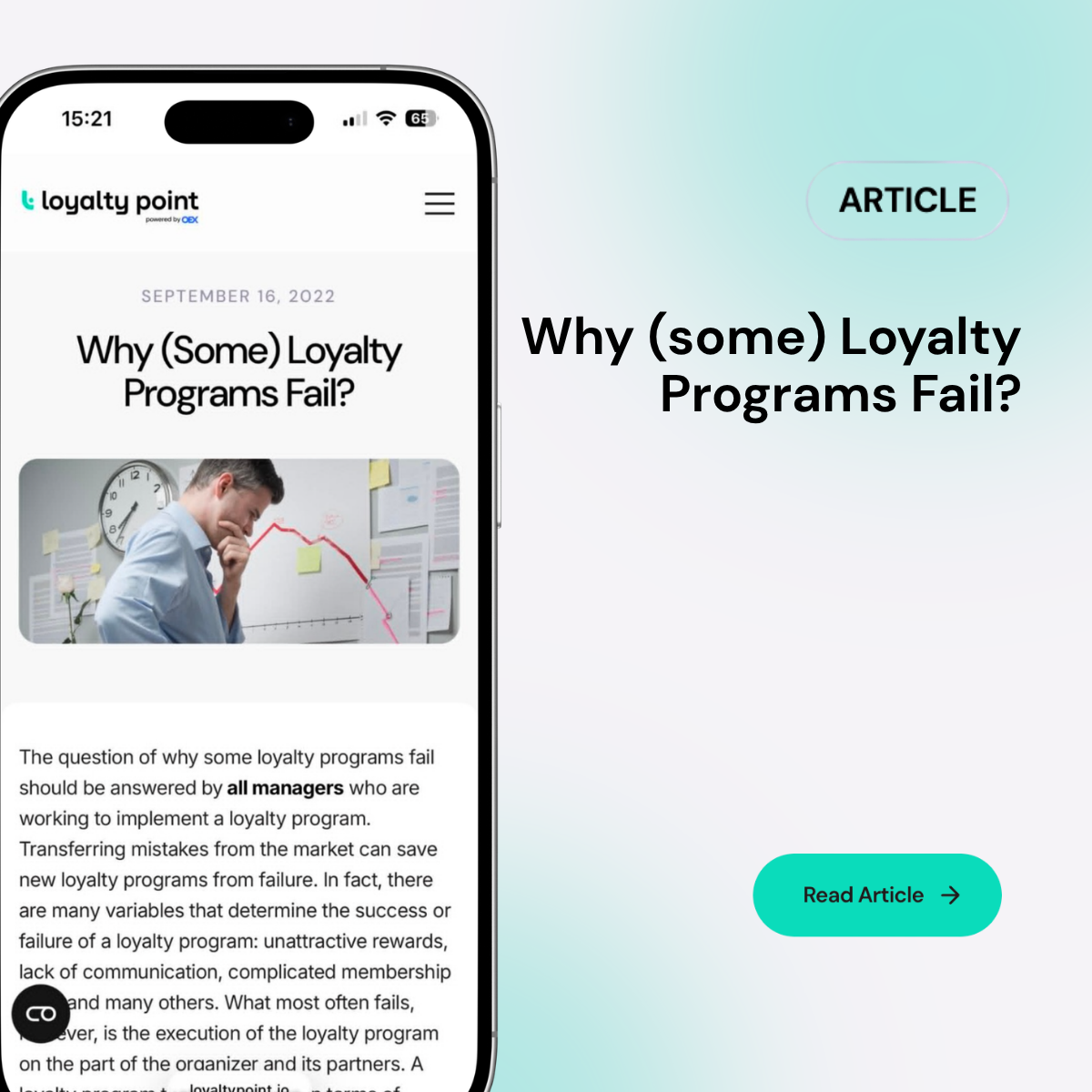
The type of program is only the surface. What determines success is the system behind it – data, technology, and the ability to act on insights in real time. This is also a key point raised in Why some loyalty programs fail, where the focus shifts away from program design itself toward execution. The article highlights that many loyalty initiatives fall short not because of the chosen mechanics, but because organizations lack the operational maturity to turn customer data into.
What High-Performing Retail Brands Do Differently in Terms of Choosing Loyalty Program Types
High-performing brands approach loyalty as an evolving system, not a one-time project. They don’t lock themselves into a single model. Instead, they layer different mechanisms over time, based on what actually works for their customers.
They invest in data – not just collecting it but using it to inform decisions and trigger actions. They move beyond campaign-based thinking and design experiences that respond to behavior continuously.
They also integrate channels. Loyalty is not treated as a separate program, but as part of the overall customer experience across touchpoints. If you look at brands like Starbucks, Sephora, or Amazon, what stands out is not a specific mechanic. It’s the consistency between data, experience, and execution. That consistency is what allows them to evolve from simple programs into fully integrated loyalty ecosystems.
Conclusion: There Is No “Best” Loyalty Program Type
There is no single best type of loyalty program. The right choice depends on your business goals, customer expectations, purchase frequency, and long-term retention strategy.
From points-based loyalty programs and tiered loyalty programs to paid membership programs, value-based loyalty programs, cashback rewards, and coalition loyalty programs, every model offers different advantages. Some brands achieve the best results by combining multiple loyalty program types into a hybrid strategy that evolves alongside their customers.
When comparing different types of loyalty programs, focus less on industry trends and more on customer behavior. Ask yourself: Which loyalty program structure encourages repeat purchases, increases customer lifetime value, and strengthens brand loyalty for my audience?
As businesses grow, their loyalty strategies often evolve from simple reward systems to sophisticated loyalty ecosystems that combine points, tiers, exclusive benefits, subscriptions, and partner rewards.
The best type of loyalty program isn't the one with the most features. It's the one that aligns with your business strategy, delivers a seamless customer experience, and creates lasting customer loyalty.
Choosing the right type of loyalty program is just the first step. If you're looking for a strategy tailored to your business and customers, Loyalty Point can help you design and implement a program that drives long-term engagement and measurable results.
Get in touch with our team and let's find the loyalty model that works for your brand.
See also