ROI in a Loyalty Program. Guide on How to Measure and Optimize Customer Loyalty Values
.png)
In the retail world, loyalty programs are often viewed through a polarized lens: either as a "must-have" marketing expense or a transformative engine for growth. However, data from EY reveals a sobering reality – 41% of loyalty leaders admit they struggle to determine the full impact of their programs.
The problem isn't a lack of data, but a lack of clarity. Many companies mistake correlation for causation, failing to distinguish between customers who are loyal by nature and those whose behavior was actually changed by the program. To turn a loyalty program from a cost center into a profit powerhouse, decision-makers must master the art of measuring Incremental ROI.
Understanding Incremental ROI: Correlation vs. Causality
It is tempting to declare victory when loyalty members exhibit higher spend, frequency, or basket size. Highvalue customers often selfselect into programs. Their superior performance can exist independent of any loyalty mechanics. To prove causality, retailers must separate the spend that would have occurred anyway from the spend that is incremental – a behavior change driven by program exposure.
The correct calculation frames ROI around incremental profit, not topline member revenue:
$\text{ROI} =\frac{\text{Incremental Revenue (R)} - \text{Total Program Costs (C)}}{\text{Total Program Costs (C)}}$
Where:
- ROI (Return on Investment) – a metric that shows how much profit is generated relative to the costs of running the loyalty program.
- Incremental Revenue (R) – the additional revenue generated as a direct result of the loyalty program (the uplift compared to the baseline).
- Total Program Costs (C) – all costs associated with the program, including technology, operations, marketing, rewards, and fulfillment.
This formulation forces an uncomfortable but necessary subtraction: the area of spend that would have happened even if the program didn’t exist. Without that adjustment, we lack the visibility to prevent loyalty from becoming a discount engine that taxes margin. With it, we gain the data necessary to transform it into a system that engineers profitable customer behavior.
Common Pitfalls That Distort ROI of Loyalty Program
If measuring loyalty ROI were simpler, every CFO would be its loudest promotor. In practice, three mistakes make reliable measurement difficult and that is why most retailers get ROI wrong:
Flawed KPIs
Many programs focus on "vanity metrics" like the number of members or app activations. These are often completely disconnected from financial outcomes like margin, purchase frequency, or Customer Lifetime Value (CLV).
The Hidden Cost of Scaling
As programs grow, so do liabilities: points outstanding, discounts, free shipping promises, operational overhead. Many organizations track issuance but not redemption economics, or treat points as “free”. Rewards have real cash and margin costs and must be measured in real time as liabilities on the balance sheet and in contribution margin analyses.
The "Discount Trap"
Treating the program as a digital coupon book rather than a retention tool. When a program only rewards existing behavior, it simply "eats" margin that was already guaranteed. Companies often sum up all member revenue as "loyalty revenue." In reality, you must subtract the amount the client would have spent without the program – to find the true incremental lift.
While these pitfalls are common, they are not inevitable. Retailers who rethink how they measure loyalty can turn ROI from a blind spot into a strategic advantage.
Where Loyalty Programs Generate ROI (The Value Pathways)
Loyalty doesn’t produce value by existing. It produces value by changing customer behavior and lowering cost to serve. It is crucial to design activities that engage participants, increase the frequency of purchases and the value of the shopping cart, and ultimately translate into a measurable ROI. What key elements does a loyalty program influence?
The most durable pathways include:
- Lower cost of reach and relevance
When your program creates owned media – app notifications, inprogram messaging – communication costs decline while targeting accuracy rises. That shift compounds as you automate journeys grounded in first party data.
- Growth in CLV through frequency and AOV lifts
Relevant missions, personalized challenges, and status incentives increase visit cadence and basket construction, thereby elevating long term value rather than just triggering one off redemptions.
- Smarter external media investments
Segmentation informed by program behavior improves audience quality for paid media, reducing waste and increasing conversion at marginal cost. A well-designed loyalty program makes all marketing more efficient, not just loyalty communications.
The chart below illustrates how different value drivers contribute to overall program ROI. Gray bars represent the base value – the amount the customer would spend if the program did not exist. Above this baseline, the chart shows the incremental revenue generated by loyalty mechanisms – such as personalized offers, gamification, and new product promotions – stacked against the baseline spend, highlighting the pathways that transform a loyalty program from a cost center into a profit engine.
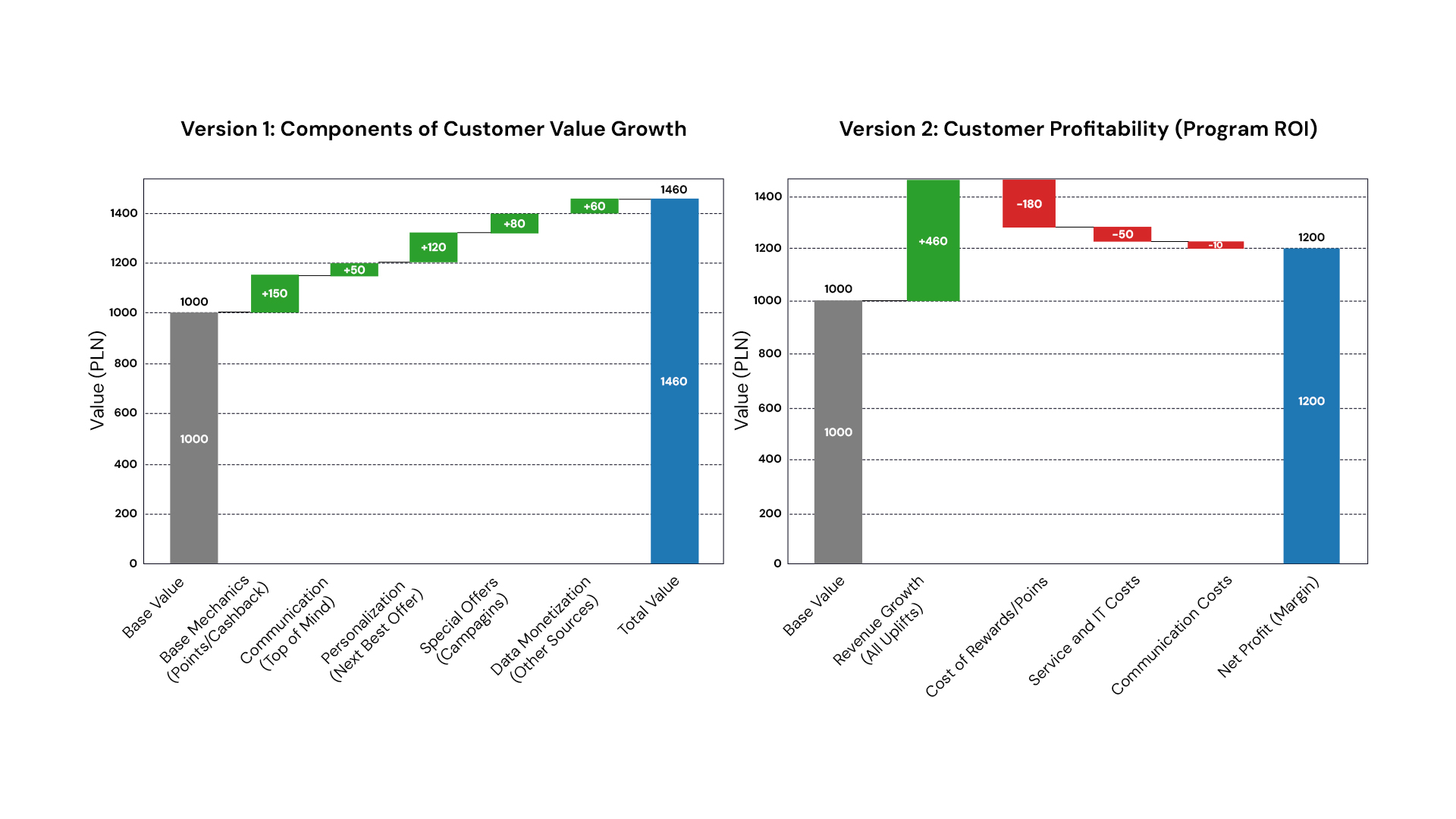
Once value pathways are clear, the remaining challenge is quantification. How do changes in engagement, frequency, or retention translate into incremental profit and measurable ROI?
What Really Creates ROI in Loyalty Programs: Personalization and Segmentation as Economic Levers
When businesses talk about ROI, the conversation often revolves around budgets, channels, and campaigns. But the real economic levers that drive sustainable growth are personalization and segmentation. These two strategies transform customer interactions into measurable value, increasing engagement, loyalty, and ultimately profitability.
Segmentation as an Operational Decision-Making Tool
Segmentation is not about creating descriptive profiles of customers. It’s about defining rules for action. Each segment should guide operational decisions, not just sit in a report.
By differentiating experiences across segments, companies can maximize Customer Lifetime Value (CLV) and incremental revenue. Segmentation becomes a framework for deciding what actions to take, for whom, and when – from offers and communication frequency to channel prioritization.
Personalization as a Loyalty ROI lever
Personalization is where segmentation comes to life. Tailored experiences lead to:
- Higher engagement
- More frequent purchases
- Increased Average Order Value (AOV)
- Higher CLV
- Ultimately, higher ROI
The mechanics of personalization can include shopping missions, thresholds, gamification, challenges, and inspirational content. These elements make interactions relevant and rewarding, turning routine transactions into meaningful experiences.
Examples of Segment-Based Decisions
- High-value customers: Offer premium deals, exclusive benefits, and priority missions.
- Low-value customers: Focus on light missions, educational content, and simple gamification.
- Churn-risk customers: Deploy reactivation offers, reminder journeys, and more intensive contact strategies.
Channel selection matters too. Whether it’s app, email, SMS, social, or offline, choose the platforms where efficiency and impact are highest.
Operational KPIs that Drive ROI
ROI is a final indicator, but operational indicators are needed to optimize the program.
Loyalty and Value Indicators:
- Customer Retention Rate (CRR): A key measure of program success.
- Purchase Frequency and Average Order Value (AOV): Does the program influence purchasing behavior?
Engagemenet Metrics:
- Activation Rate: Percentage of members who have made their first interaction in the program.
- Redemption Rate: Shows the attractiveness of rewards (too low = rewards are unattractive; too high = the program is costly).
- NPS (Net Promoter Score) / Social Engagement: Measures emotional loyalty and willingness to recommend.
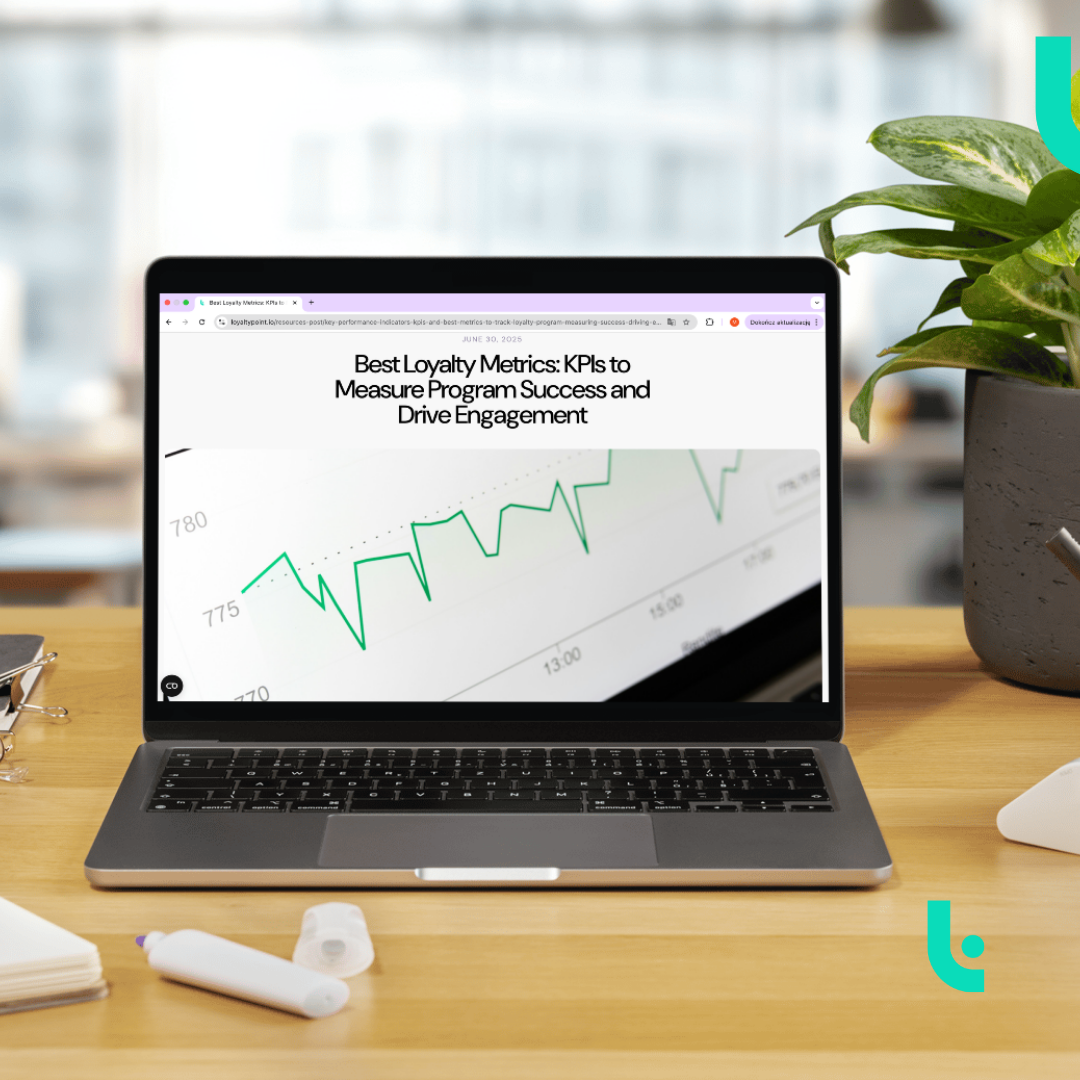
If you want to learn more about loyalty program performance indicators, read the article Best Loyalty Metrics: KPIs to Measure Program Success and Drive Engagement
Measuring ROI Across the Program Lifecycle
Measuring ROI is not a one-time exercise. It evolves as the program matures. Each stage of the lifecycle requires different metrics and methodologies to validate assumptions, track performance, and optimize profitability.
Pre-launch – Build a Defensible Business Case
Model CLV scenarios – optimistic, realistic, conservative – based on expected frequency and AOV changes by segment. Forecast total costs with reward liability ranges. Define test plans you’ll execute after launch to validate assumptions. The business case is a hypothesis; your measurement plan is how you’ll prove or pivot.
Post-launch (0–12 months):
Instrument the leading indicators. Early signals include member acquisition, activation rates, share of identified transactions, and member vs. nonmember basket and frequency. These prove engagement while you accumulate enough data for causal analyses. During this phase, ask whether engagement grows faster than program costs and whether early uplift tests support your businesscase assumptions.
Mature Program (12+ months):
Operate on quarterly ROI cycles. Update attribution models with fresh data, monitor redemption economics to avoid liability spikes, and maintain a program health score that blends retention, activity, cost per point, and channel effectiveness. Treat ROI as a living KPI: trend shortterm and longterm values, and dissect performance by segment to inform resource allocation.
Optimization & Decision Making in Loyalty Programs Guided by ROI
Using ROI as a guiding principle enables businesses to make smarter decisions that balance cost efficiency with revenue growth. Effective optimization requires a dual focus: reducing unnecessary costs while unlocking incremental value.
Optimizing Program Costs
The first step toward ROI-driven decision-making is cost discipline. This means:
- Identify rewards with low return rates. Not all benefits deliver equal value. Analyze which rewards fail to generate incremental behaviors and eliminate them.
- Remove incentives that don’t drive desired actions. Every benefit should encourage measurable engagement or purchases. If it doesn’t, it’s a cost without impact. However, this evaluation must distinguish between immediate conversion and long-term loyalty. While cutting certain 'soft' benefits might boost short-term ROI, it can inadvertently erode Customer Lifetime Value (CLV) if those perks were foundational to brand affinity and retention.
Maximizing Revenue
ROI isn’t only about cutting costs – it’s about unlocking growth. Tailored experiences lead to higher Average Order Value (AOV) and more frequent purchases, which directly increase Customer Lifetime Value (CLV).
To achieve this:
- Test mechanics that boost customer value. Experiment with gamification, challenges, and tiered benefits to discover what drives incremental revenue.
- Personalize offers and journeys. Relevance amplifies engagement and accelerates behavioral change.
The ROI of a loyalty program is never obvious – it needs to be demonstrated and justified. The true strength of a program is not measured by the number of participants but by its impact on behaviors that generate value.
Precise measurement and the right technology determine whether a program becomes an investment or a cost. Without clear data and actionable insights, even the most attractive program risks turning into an expense rather than a growth driver.
Overcoming Measurement and ROI Optimalization Challenges
Measuring ROI is complex because loyalty programs rarely operate in isolation. Marketing campaigns, seasonal promotions, and omnichannel strategies all influence customer behavior. Without robust attribution models, it’s impossible to know what portion of revenue is truly driven by the program.
Other common challenges include:
- Channel fragmentation
When programs function only online or in selected touchpoints, customers experience inconsistency, reducing engagement and limiting measurable impact. The solution is full integration – ensuring that rewards and benefits apply across every channel, from physical stores to apps and e-commerce.
- Over-reliance on transactional rewards
Points and discounts may boost short-term engagement, but they rarely build emotional loyalty or long-term value. To optimize ROI, programs must evolve beyond rebates and incorporate experiences, exclusivity, and personalized journeys.
Loyalty Program ROI Measurement Essentials: Data and Methods You Can’t Ignore
No ROI framework survives poor data. A few hygiene rules determine whether your numbers will withstand CFO scrutiny:
Clear KPIs
Financial and operational KPIs that tie to profit. Retention, frequency, AOV, CLV, and incremental profit must anchor the scorecard. Operational health metrics – member activation rates, share of transactions with identified accounts, reward redemption rates, and program health scores – translate engagement into economic impact.
Unified Data
Unified customer identity across channels. One customer ID must connect instore POS, ecommerce, app, and service centers. Fragmented identity destroys attribution and clouds baseline definitions. Consent management and privacybydesign are not only regulatory necessities – they enable reliable measurement.
Causal Methodology
Establish clean “base” periods and define control groups untouched by program stimuli when feasible. Use uplift modeling to separate loyalty impact from other marketing touchpoints. Keep measurement windows consistent with purchase cycles to avoid false positives or negatives.
Once the measurement foundation is in place, the question shifts from “Can we measure loyalty ROI?” to “Where exactly does it come from?”
Practical Scenario: Proving Incremental ROI in Grocery
Consider a regional grocer launching a tiered program with missionbased challenges. The team runs a sixweek A/B test across matched store clusters. The “A” group receives a mission: “Spend 60 dollars twice this month to unlock 10 dollars off produce.” The “B” group sees no mission, only standard earnandburn points.
Results show that participating households in “A” increased trip frequency by 0.6 visits and lifted AOV by 4 dollars compared to matched controls. After subtracting baseline trend, the incremental revenue per participating household is 34 dollars. With a 32% gross margin and 6 dollars average reward COGS, incremental profit is 4.88 dollarsper household. Program costs for the mission (setup, media within the app, and analytics) total 1.50 dollarsper targeted household.
Incremental ROI = 4.88 / 1.50 ≈ 3.25x over six weeks
The team then scales the mission selectively to segments where response was strongest, maintains economic guardrails by adjusting thresholds, and tracks CLV changes over the next quarter to validate compounding value. This is loyalty as a profit system – not a discount catalog.
How to Present Loyalty ROI to the Executive Team (Without “Gaming” the Numbers)
Executives don’t need pages of charts. They need proof. Anchor your narrative on three elements:
- Evidence of causality
Present testcontrol results or uplift modeling outputs that isolate the program’s effect. Show the baseline and the incremental lift with confidence intervals where possible.
- Translation to economics
Move from lift to profit using productlevel margins and the real cost of rewards. Make liabilities visible – points issued vs. Redeemed – and explain the guardrails that keep economics healthy.
- Compounding value story
Compare CLV of members versus nonmembers over time, then attribute the delta proportionally to program mechanics tested. Break results down by segment to demonstrate where the program truly pays back and where optimization is required. Close with shortterm vs. longterm ROI trends to show momentum.
This reporting discipline turns debate into decision, enabling finance to greenlight additional investment where the model shows compelling returns.
How to calculate Loyalty Program ROI for your case?
ROI is not a vanity number. It is the executivelevel proof that your program creates incremental profit. The three questions that determine success are straightforward: Are we measuring KPIs that tie to financial outcomes? Are segments driving operational rules, not just descriptions? And can we credibly separate “program” revenue from “baseline” revenue?
If your organization needs to transform loyalty from a discount line item into a growth asset, we help teams establish the data hygiene, causal methodology, and optimization playbooks that convert membership into measurable, defensible ROI. Let’s turn your loyalty program into an investment your CFO champions – because the numbers prove it.
In Loyalty Point, we help companies move their loyalty programs from the expense category to the investment category. Schedule a consultation and learn how to improve the ROI of your loyalty program.